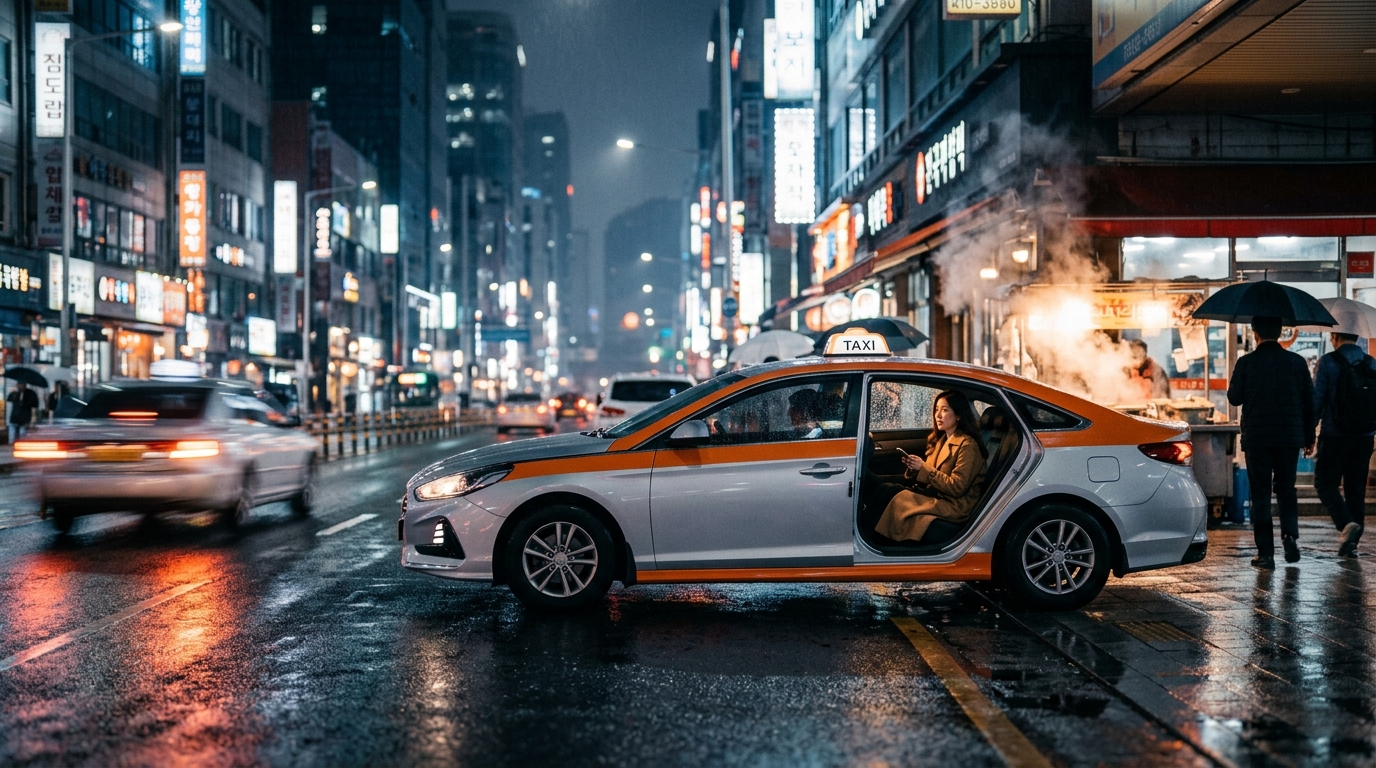
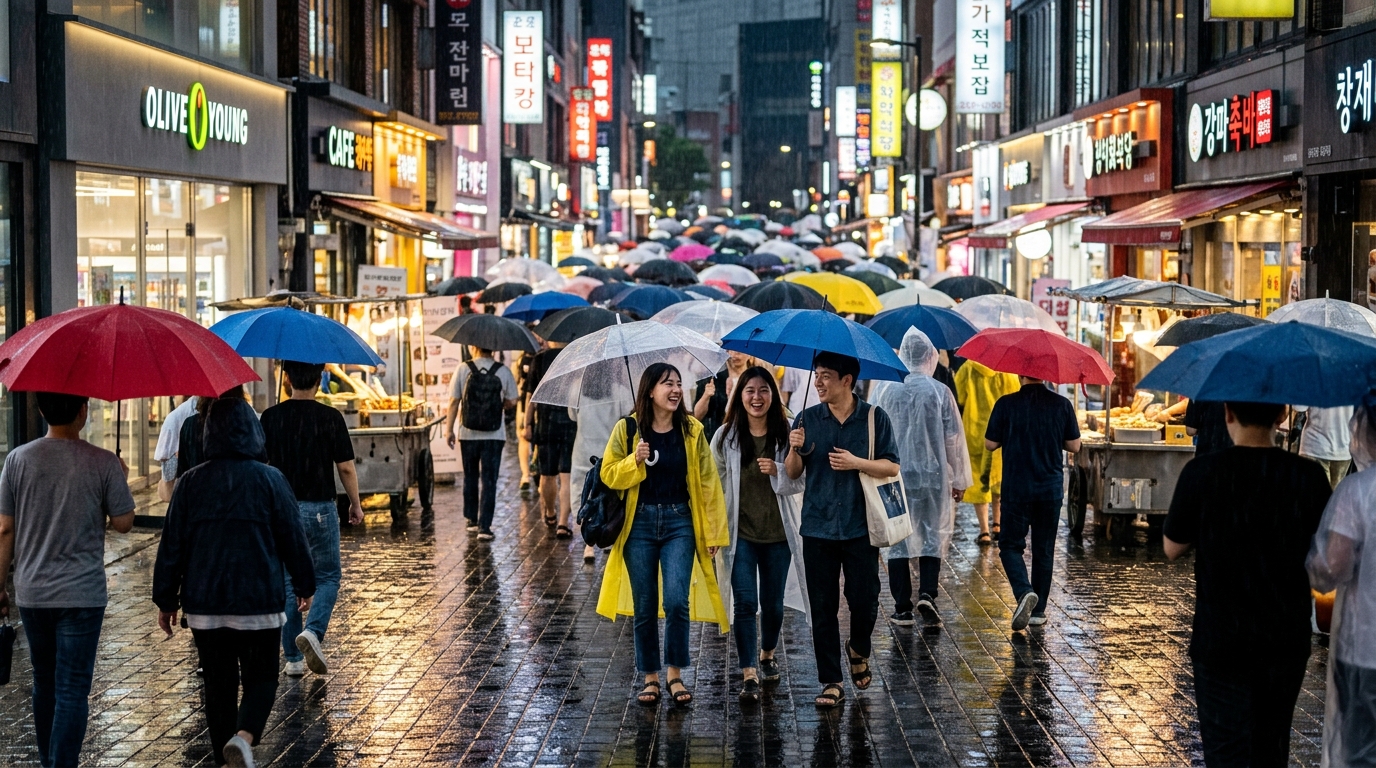
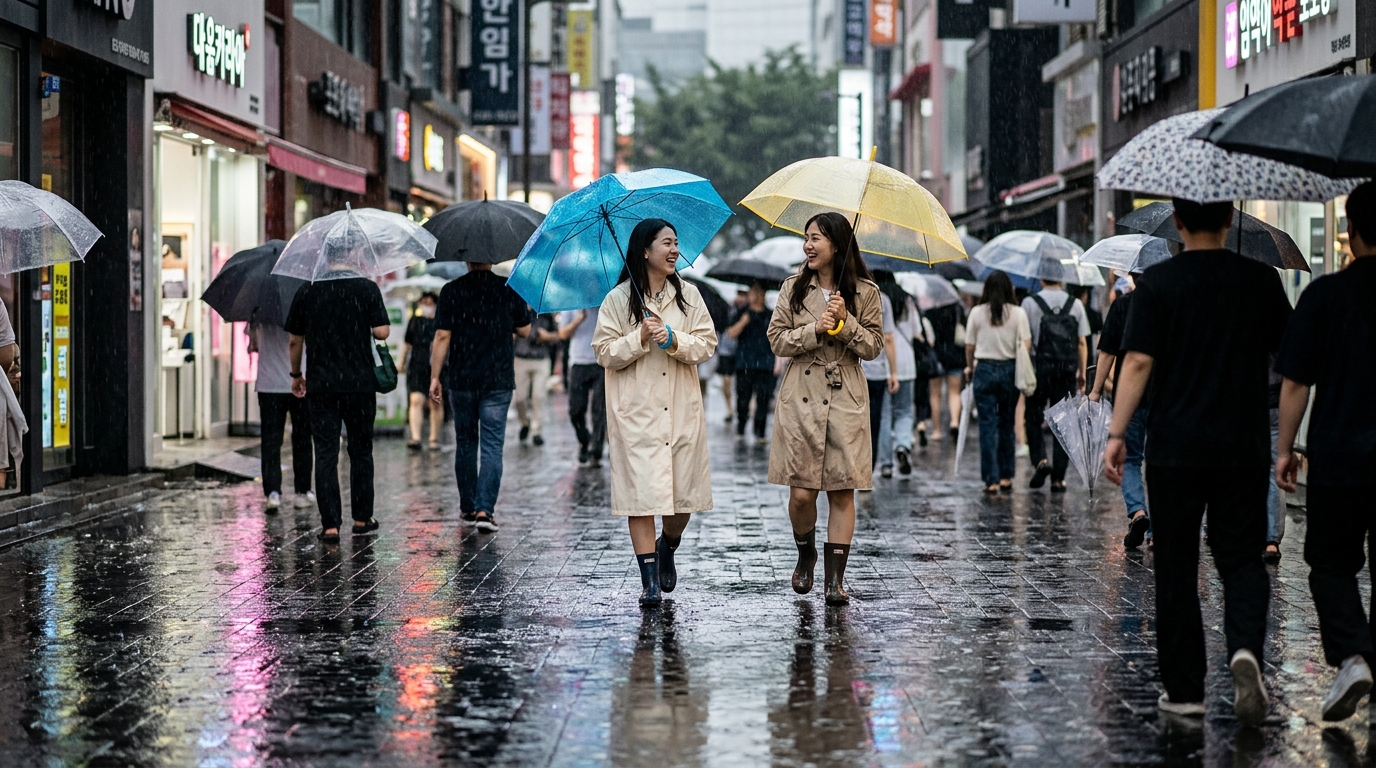
Quick answer: Choose Myeongdong for a central first-trip base and shopping, Hongdae for airport access and nightlife, Gangnam for modern Seoul and business appointments, or Jongno for palaces, traditional neighborhoods, and walkable historic sights. The best area is the one that reduces your longest daily trips—not the one with the most famous name.
Hongdae street scene. Photo: U0894629/Wikimedia Commons, CC BY-SA 4.0.
Choose by itinerary, not by ranking
Area
Best for
Main trade-off
Myeongdong
First-time visitors, shopping, central access
Busy and tourist-oriented
Hongdae
Young travelers, nightlife, airport rail
Longer rides to some southeast-Seoul sights
Gangnam
Business, K-beauty, COEX, modern districts
Farther from palaces and traditional north Seoul
Jongno
Palaces, Bukchon, museums, traditional Seoul
Quieter nights in some blocks
Myeongdong: easiest all-round base
Myeongdong works well when your itinerary mixes N Seoul Tower, shopping, central markets, palaces, and day tours. Multiple subway options are nearby, and airport buses serve the wider district. It is convenient for a short first trip when you do not want to research every transfer.
Choose it if: you want central convenience, shop late, prefer many hotels, or have only three to four days. Skip it if: your priority is local nightlife or most appointments are in Gangnam.
Myeongdong at night. Photo: Adbar/Wikimedia Commons, CC BY-SA 3.0.
Hongdae: best for airport access and nightlife
Hongdae connects directly to Incheon Airport on the AREX all-stop line and has late-night food, music, cafes, and shopping. It is a strong choice for solo travelers and younger visitors who want activity near the hotel.
Choose it if: airport access, nightlife, live music, or western Seoul matters. Skip it if: you want a quiet atmosphere or plan to spend every morning around the royal palaces.
Gangnam: best for modern Seoul and appointments
Gangnam is practical for COEX, convention events, clinics, business meetings, and neighborhoods south of the Han River. Accommodation can be polished and transport is extensive, but crossing Seoul to Jongno or Hongdae repeatedly costs time.
Choose it if: your fixed appointments are in Gangnam, Jamsil, or southern Seoul. Skip it if: palaces, traditional markets, and northwest Seoul dominate the trip.
Jongno: best for history and walkable sightseeing
Jongno puts Gyeongbokgung, Changdeokgung, Insadong, Ikseondong, museums, and traditional streets close together. It is ideal for early starts and travelers who prefer culture over clubs.
Choose it if: you want palaces, hanok areas, museums, and local walking routes. Skip it if: late-night entertainment at the doorstep is essential.
Use this three-step method
List the three places you must visit and mark them on a map.
Choose the area that minimizes repeated cross-city travel, not the single longest airport trip.
Check the exact hotel’s walk to a subway entrance, airport-bus stop, and main road. A hotel “in Myeongdong” can still be inconvenient with luggage if it sits uphill or far from transport.
Best area by traveler type
First visit, 3–4 days: Myeongdong or Jongno
Solo traveler who enjoys nightlife: Hongdae
Family focused on sightseeing: Myeongdong or Jongno, depending on hotel room and elevator access
Business or convention trip: Gangnam near the actual venue
Late arrival from Incheon: Hongdae or a hotel with a direct airport bus
Heavy luggage: prioritize a direct bus stop, elevator access, and short walk over neighborhood prestige
Hotel checks that save problems later
24-hour front desk or late check-in instructions
Elevator access and room size
Real walking route from the station—not straight-line distance
Airport transport after your expected arrival time
Laundry, luggage storage, and breakfast hours
Noise comments that mention the exact room or floor
It is tourist-oriented, but that can be useful on a first short trip because English support, shopping, transport, and hotels are concentrated. Choose another area if neighborhood atmosphere matters more than convenience.
Is Hongdae good for families?
It can be, especially near the airport rail, but check nighttime noise and the walking route. Quieter streets outside the busiest core may work better.
Should I stay near Seoul Station?
It is useful for AREX and intercity trains, but the immediate area may not match every traveler’s evening plans. Compare it with Myeongdong and Jongno based on your itinerary.
Can I change hotels during a five-day trip?
You can, but packing and check-in time often cancel the transport savings. Split stays make more sense when the trip has clearly separate phases, such as Seoul followed by another city.
Quick answer: Ask for a tax-refund receipt when you pay, keep the purchased goods available for inspection, and complete the correct refund path before leaving Korea. If the store gives an instant tax refund, the tax is deducted at purchase after eligibility checks. Otherwise, validate the refund receipt at an airport kiosk or counter. For goods packed in checked luggage, complete any required customs inspection before checking the bag.
Myeongdong shopping street. Photo: Adbar/Wikimedia Commons, CC BY-SA 3.0.
First identify which refund you have
Type
What happens
Your next step
Instant refund
Eligible tax is deducted at the store
Keep receipts and goods; confirm no airport step is requested
Airport/city refund
You receive a refund document
Validate it at the designated kiosk or counter
Ordinary receipt only
No refund document was created
Ask the store immediately; the airport may not be able to recreate it
Who is generally eligible?
Tax-refund shopping is designed for qualifying foreign visitors and eligible overseas Koreans who export the goods within the permitted period. Your immigration status, time in Korea, purchase amount, product category, and store participation matter. A “Tax Free” or “Tax Refund” sign does not mean every item or customer automatically qualifies.
At the store: do these five things
Confirm the shop participates in the tax-refund program before paying.
Carry the passport or accepted identity information required by the store.
Ask whether the transaction is an instant refund or requires later validation.
Check your name, passport details, purchase amount, and refund operator on the document.
Keep the receipt, refund form, and goods together until departure.
At the airport: checked-bag problem
If the purchased goods may need customs inspection and you plan to put them in checked luggage, do not hand over the suitcase first. Tell the airline check-in staff that you have tax-refund goods, then follow the airport’s current customs and refund procedure. The order can differ by terminal, refund operator, transaction value, and whether inspection is required.
Arrive earlier than usual. A refund queue, customs check, incorrect receipt, or kiosk rejection can take time.
Carry-on vs. checked luggage
Carry-on: easier to present for inspection, but liquids and security restrictions still apply.
Checked bag: useful for bulky items, but any required inspection must happen before the bag disappears into the baggage system.
What can cause a refund to fail?
The store is not an authorized participant.
You lost the refund document or the passport data is wrong.
The goods were opened, consumed, or unavailable for inspection when required.
The purchase or traveler is outside the current eligibility rules.
You checked the luggage before completing a required customs step.
The payment/refund method cannot receive the refund as expected.
If the kiosk rejects the receipt
Read the error message and confirm the correct refund operator.
Check whether you are at the correct terminal and kiosk.
Use the staffed counter listed on the receipt or airport map.
Keep the goods, passport, boarding pass, and payment card available.
Do not leave the secured departure process until you understand whether another step is still possible.
No. Eligibility depends on the traveler, store, item, purchase, and export rules.
Can I claim a refund without the special receipt?
Usually the participating store must create the refund record. Ask at the store before leaving; an ordinary card receipt alone may not be enough.
Can I use the product before departure?
Some refunded goods must remain unused and available for export verification. Follow the rule shown on the refund document and official guidance.
Should I check in first?
If refund goods are in checked luggage and inspection may be required, tell airline staff before the bag is accepted. Follow the airport’s current sequence.
Thresholds, eligible items, refund limits, operators, and airport procedures can change. Confirm the latest official instructions and the terms printed on your refund document.
Quick answer: Eligible foreign visitors can submit Korea’s electronic arrival declaration through the official e-Arrival Card website within three days before arrival, based on Korea Standard Time. Travelers exempt from the arrival declaration do not need to submit it. Use only the official government address, verify passport details carefully, and keep the confirmation available offline.
Incheon International Airport. Photo via Wikimedia Commons, CC BY 2.0.
What problem does the e-Arrival Card solve?
It replaces the paper arrival declaration for travelers who must submit arrival information. It is not a visa and it is not the same as K-ETA. Having a visa or K-ETA question does not automatically answer whether an arrival declaration is required, so check the current official exemption list.
Do you need to submit it?
The official guidance lists exemptions such as registered residents and certain travelers whose entry information is already covered by another process. Rules can change, so use the government eligibility guidance rather than a travel forum screenshot. If you are not exempt, submit the electronic card or follow the current arrival-declaration procedure available to you.
When to submit
You can submit it from three days before your arrival date. The window follows Korea Standard Time. For example, a late-night departure from another time zone can create confusion, so calculate from the date you will enter Korea—not the date you leave home.
Prepare these details first
Passport biographical information
Flight or vessel details
Arrival and departure dates
Address and contact information for your stay in Korea
Purpose of visit and other requested travel information
Use the accommodation name and address shown by the hotel or host. Copying a precise address is safer than typing from memory.
Step-by-step submission
Open the official government e-Arrival Card website directly.
Select individual or group submission as appropriate.
Read and accept the required terms.
Enter passport details exactly as printed.
Add arrival, departure, accommodation, and contact information.
Review every field before submitting.
Save or screenshot the confirmation for offline access.
How to avoid fake or paid sites
Start from an official Korean government or VISITKOREA page.
Check the web address before entering passport data.
Do not trust sponsored search results solely because they appear first.
Be suspicious of unnecessary service fees or promises of guaranteed entry.
Never send passport scans through an unverified messenger account.
The official electronic arrival declaration should not be confused with commercial form-filling services. A third party cannot guarantee admission to Korea.
Common mistakes and fixes
Wrong arrival date
Use the date the aircraft arrives in Korea, accounting for time-zone changes.
Hotel address missing
Find the property’s full Korean or English address in your booking confirmation. Contact the accommodation if the address is unclear.
Passport name entered differently
Match the passport machine-readable information exactly. Do not add a nickname.
Plans changed after submission
Follow the official site’s current edit or resubmission instructions. Do not guess whether an old submission remains valid after a major change.
No. It is an arrival declaration. Visa and K-ETA requirements are separate.
Can I submit it weeks early?
No. The official submission window opens three days before arrival, based on Korea Standard Time.
Do children need one?
Check the official exemption and group-submission guidance for each traveler. A parent can prepare the submission, but do not assume the child is automatically excluded.
Do I need to print it?
Follow current official instructions. Saving the confirmation offline is sensible in case airport Wi-Fi or mobile data is unavailable.
Quick answer: Choose a data-only eSIM if your unlocked phone supports eSIM and you mainly need maps, messaging, translation, and ride-hailing. Choose a Korean SIM with a local number if you expect reservation calls, delivery contacts, business communication, or services that require SMS verification. Do not buy by data allowance alone—the real decision is whether you need a Korean phone number.
Incheon Airport Terminal 1. Photo: AirportTerminalGuy/Wikimedia Commons, CC BY 4.0.
Choose in 30 seconds
Need
Best fit
Internet immediately after landing
Preinstalled eSIM
Local calls or Korean SMS
Voice/SMS-capable Korean SIM
Phone does not support eSIM
Physical SIM or pocket Wi-Fi
Several devices or family sharing
Pocket Wi-Fi or hotspot-capable plan
The problem most travelers miss: a phone number
Many low-cost travel eSIMs provide data only. That is enough for Google Maps, Naver Map, KakaoTalk, WhatsApp, email, and web browsing. However, data access does not automatically give you a Korean number for incoming calls or verification texts.
If a hotel, restaurant, clinic, tour company, or delivery driver may need to call you, look for a plan that explicitly includes a Korean voice number. Never assume that “unlimited data” includes calls or SMS.
Check these four things before paying
Carrier lock: Your phone must be unlocked.
eSIM support: Check the exact model and regional variant, not just the product family.
Activation rule: Some plans start when installed; others start when first connected in Korea.
Number type: Confirm whether the plan is data-only, incoming-call only, or full voice/SMS.
Will maps and travel apps work?
Internet-based apps work on a data-only plan, but some Korean services may request a local phone number or identity verification for account features. Install essential travel apps before departure and keep your home SIM available for banking or account security messages if roaming charges are controlled.
Advantages: no airport queue, fast setup, keep your physical SIM slot, easy plan comparison.
Limits: device compatibility, activation mistakes, and many plans have no Korean number.
Install the eSIM while you still have reliable Wi-Fi, save the QR code and instructions offline, and do not delete the profile until the trip ends.
Physical SIM: advantages and limits
Advantages: staff can help activate it, local-number options are clearer, and it works on compatible phones without eSIM.
Limits: airport collection hours, possible queues, and you must store your home SIM safely.
Pocket Wi-Fi: when it is better
Pocket Wi-Fi can make sense for multiple travelers or several devices. The trade-offs are another battery to charge, a device to return, and the risk that the group loses internet when members separate.
Safe setup checklist
Confirm that your phone is unlocked.
Verify the exact model supports Korean LTE/5G bands and eSIM if needed.
Decide whether a Korean phone number is essential.
Compare total trip cost—not an advertised daily price alone.
Save activation support contact details offline.
Turn off data roaming on the home SIM unless you intentionally use it.
Test maps and messaging before leaving the airport.
Frequently asked questions
Can I use WhatsApp or KakaoTalk with a data-only eSIM?
Yes, once the account is already set up. The apps use data, although new-account verification can still depend on an SMS-capable number.
Can I keep my home number active?
Many dual-SIM phones allow it, but settings vary. Set the Korean line as mobile data and control roaming on your home line to avoid unexpected charges.
Should I buy at Incheon Airport?
Airport counters are useful if you want staff assistance or a physical SIM. A preinstalled eSIM is more convenient when your phone is compatible and you understand the activation steps.
Is unlimited data always fast?
No. Read the fair-use and speed-reduction terms. “Unlimited” may include throttling after a daily or total allowance.
Quick answer: Take the AREX Express if your hotel is near Seoul Station and you value speed. Take an airport limousine bus if it stops close to your hotel and you have heavy luggage. Choose a taxi for late-night arrivals, families, or door-to-door convenience. The cheapest option is usually the AREX all-stop train, but the best option depends on your final destination—not the airport alone.
AREX airport train in Korea. Photo: Wikimedia Commons, CC BY-SA 3.0.
Choose in 30 seconds
Your situation
Best first choice
Why
Hotel near Seoul Station
AREX Express
Fast, reserved seating, no road traffic
Hongdae or Gimpo Airport area
AREX all-stop
Direct stops without backtracking from Seoul Station
Myeongdong, Dongdaemun, Gangnam hotel near a bus stop
Airport limousine bus
Less lifting and fewer transfers
After public transport hours, 3–4 travelers, children, or many bags
Official taxi stand
Door-to-door and cost can be reasonable when shared
AREX Express: fastest for Seoul Station
The nonstop AREX Express runs between Incheon Airport and Seoul Station. The official Korea Tourism Organization guide lists approximate travel times of 43 minutes from Terminal 1 and 51 minutes from Terminal 2. It is ideal when Seoul Station is your destination or when your next train departs from there.
Do not choose it only because the word “Express” sounds best. If you are staying in Hongdae, the all-stop train serves Hongik University Station directly. Riding the express to Seoul Station and then traveling back west wastes time.
AREX all-stop: best value for several western Seoul stops
The all-stop train takes roughly 59 minutes from Terminal 1 and 66 minutes from Terminal 2 to Seoul Station, according to VISITKOREA. It stops at places including Gimpo Airport, Digital Media City, and Hongik University. It is usually the practical choice for budget travelers and Hongdae stays.
You can use a Korean transport card for many local transit trips. Before arrival, read our T-money Card in Korea guide so you know where to buy, reload, and refund it.
Airport limousine bus: easiest with luggage
A limousine bus can beat the train when it stops close to your accommodation. This is especially useful in Myeongdong, Dongdaemun, Gangnam, Jamsil, and other hotel districts where a rail trip may require a subway transfer and stairs.
Check the exact bus number and stop on the airport or operator website.
Compare the bus stop with your hotel on a map before buying a ticket.
Allow extra time during weekday rush hours or bad weather because buses use roads.
Confirm the last departure if your flight arrives late.
Taxi: best for late nights, groups, and door-to-door travel
Use the designated taxi stands outside the terminal. Incheon Airport warns travelers to avoid illegal solicitation and unlicensed rides. A regular taxi is often the simplest solution after the last convenient train or bus, and the per-person cost becomes more competitive for a group.
Have your hotel name and address written in Korean. Confirm that the driver uses the meter and understand that expressway tolls and late-night surcharges may apply. For large parties or oversized luggage, use an official van or jumbo taxi service rather than accepting an unsolicited offer inside the terminal.
Decision by hotel area
Hongdae
Start with the AREX all-stop train. Hongik University Station is direct from the airport, so the express usually adds an unnecessary transfer.
Seoul Station
Choose the AREX Express when its timetable fits your arrival. The all-stop train is the lower-cost alternative.
Myeongdong
Compare a direct limousine bus with AREX plus subway or taxi. With heavy bags, a bus stop near your hotel often matters more than a small time difference.
Gangnam or Jamsil
A direct limousine bus or taxi is often easier. The rail route can require crossing central Seoul and transferring.
What to do after landing
Check whether you landed at Terminal 1 or Terminal 2.
Open your hotel address and nearest station or airport-bus stop.
Check the live final departure time; do not rely on an old screenshot.
Buy the ticket only after confirming the route.
If plans fail late at night, use the official taxi queue.
No. AREX is predictable to Seoul Station, but your total door-to-door time may be longer if you then transfer to the subway and walk with luggage. A direct bus can be easier and sometimes faster for the hotel.
Can I use T-money on AREX?
T-money works for the all-stop train and local transit. The AREX Express uses its own ticket and reserved-seat system.
What if my flight lands after midnight?
Check current late-night bus and train notices on the day of travel. If no convenient service remains, use a designated airport taxi stand. Do not accept rides from solicitors inside the terminal.
Should I book a private transfer?
It can be worthwhile for families, large luggage, mobility needs, or a very late arrival. Compare the total group price with an official taxi or van before booking.
Updated July 26, 2026. This guide was checked against current information from the Korea Tourism Organization and Seoul Metropolitan Government.
Direct answer: For most short-term visitors, a standard T-money card is still the simplest way to pay for buses and subways across Korea. Buy one at a participating convenience store or subway service point, add Korean won, and tap when entering and leaving public transport. The card can also be used at many affiliated shops that display the T-money logo.
Solve your T-money question in 2 minutes
Choose the situation that matches what you need now. Each guide gives the shortest safe answer first, followed by official limits, exceptions, and a step-by-step checklist.
A representative T-money card. Photo: Zisk, public domain, via Wikimedia Commons.
T-money is useful because it removes the need to buy a separate ticket for every ride and makes eligible transfers easier. However, it is not automatically the cheapest choice for every itinerary. Travelers staying only in Seoul and riding public transport many times a day should also compare the short-term Climate Card, while visitors taking only a few rides may be better off simply loading a small balance onto T-money.
What Is a T-money Card?
T-money is a rechargeable prepaid transportation card. It can be used on major public transportation systems in Korea, including city buses and subways, and at affiliated merchants displaying the T-money logo. You do not need a Korean bank account to use the standard physical card.
The card has two separate costs: the price of the physical card and the money you load onto it. Buying the card does not include unlimited travel. Think of the card itself as a reusable wallet for transit fares.
Where Can Travelers Buy T-money?
According to the Korea Tourism Organization, standard T-money cards are sold at participating convenience stores nationwide, including major chains such as GS25, CU, and 7-Eleven. They are also available at customer service locations in many Seoul subway stations. Stock and card designs vary, so a specific character or limited-edition design may not be available at every branch.
At a convenience store, ask for a “T-money card” and say how much money you want to load. Keep the card after your trip if you expect to return to Korea; the physical card can normally be reloaded rather than replaced.
How much should you load first?
There is no single correct amount. Estimate the number of rides before your next convenient reload point and add a modest buffer. A smaller first load reduces the refund problem at the end of the trip. Travelers who will use airport rail, intercity transport, or taxis should confirm separately whether the exact service accepts T-money and what fare will apply.
How to Reload a T-money Card
You can reload T-money at participating convenience stores and compatible subway charging machines. At a store, hand the card to the cashier and state the amount in Korean won. At a subway machine, select the transportation-card reload option, place the card on the reader, insert the requested payment, and wait for the confirmation before removing the card.
A ticket vending and card reload machine in the Seoul metropolitan subway. Photo: Okdogi, CC BY-SA 4.0, via Wikimedia Commons.
Payment options can differ by machine and location. Do not assume every foreign-issued card will work for every reload transaction. Carrying some Korean won remains a practical backup, and the official machine screen should be treated as the final authority at the time of use.
How to Use T-money Correctly
Subway
Tap the card on the gate reader when entering and again when exiting. Wait for the reader to confirm the transaction. If the gate rejects the card, do not repeatedly force your way through; use the nearby help intercom or speak to station staff.
Bus
Tap when boarding and tap again before getting off. The second tap matters because it records the completed trip and helps apply eligible transfer rules. Forgetting to tap off can lead to an incorrect fare or loss of a transfer benefit.
Taxi and shops
Many taxis and affiliated stores accept T-money, but acceptance is not universal. Look for the T-money logo or ask before relying on it as your only payment method. Keep a second payment method available.
T-money vs. the Short-term Climate Card
Question
T-money
Short-term Climate Card
Charging model
Pay per ride from a stored balance
Unlimited eligible transport during the selected period
Best for
Flexible travel across multiple Korean cities and mixed transport
Heavy sightseeing mainly within the covered Seoul network
Coverage caution
Check the individual operator or merchant
Not every route or boarding point is covered
Main planning risk
Leaving too much unused balance
Buying a pass that does not match your routes
The Climate Card should not be chosen only because it says “unlimited.” Check the official service area and your actual route plan first. T-money is usually easier when your trip includes different regions or when you do not expect enough Seoul rides to justify a time pass.
How Refunds Work
Refund locations and limits depend on the remaining balance and outlet. The Korea Tourism Organization notes that larger balances may require a designated T-money service location rather than a convenience store. Fees and limits can change, so verify the current rule on the official T-money guidance before making a special trip.
The easiest strategy is prevention: reload in smaller increments during the final days of your visit. Remember that the price paid for the physical card is generally separate from the stored balance.
Common Mistakes to Avoid
Buying too much credit immediately: Start with a realistic amount and reload when needed.
Forgetting to tap off a bus: This can affect fare calculation and transfers.
Assuming every service accepts T-money: Confirm acceptance for intercity routes, airport services, taxis, and stores.
Removing the card too quickly: Wait for the reader or charging machine to show confirmation.
Treating an old blog price as current: Card prices, pass prices, refund rules, and service areas can change.
Relying on one payment method: Keep some cash or a separate card for exceptions.
If you plan to move around Seoul with bags, read our 2026 guide to Seoul subway luggage storage. It explains how to plan a station stop without unnecessary backtracking.
Frequently Asked Questions
Can I buy T-money at Incheon Airport?
Participating convenience stores and transportation facilities at the airport commonly sell transportation cards, but inventory and operating hours can vary. Follow current airport signage or ask at an open convenience store after arrival.
Does T-money expire?
The card is designed to be reusable. Keep it for a future trip, but check the current issuer policy if it has been unused for a very long time or appears damaged.
Can two people share one card?
Each traveler should normally have a separate card for subway gates and transfers. One card cannot be used by two people to pass through the same subway gate in the standard way.
Is T-money accepted everywhere in Korea?
It is widely accepted, but not literally everywhere. Confirm the operator, route, or merchant when the service is outside ordinary city buses and subways.
Should I choose T-money or a Climate Card?
Choose T-money for flexible pay-per-ride travel, especially across regions. Compare the Climate Card when most of your travel is inside its Seoul coverage area and your expected number of eligible rides makes the pass worthwhile.
Quick Checklist
Buy from a participating convenience store or station service point.
Load only what you reasonably expect to use.
Tap both on and off buses.
Keep a backup payment method.
Check official coverage and refund rules before relying on old prices.
Editorial note: This article does not claim personal use or testing. Product names and service details are presented for travel planning, and current official notices should take priority if conditions change.
Choosing the right Korean ramen requires understanding the difference between soup-based and dry stir-fry styles. · Illustrative AI image
Researched in Korea — We check Korean-language local sources and direct official information, then explain the practical details in clear English.
If you have visited a Korean convenience store, you know the "ramyeon wall"—a massive display of dozens of noodle varieties that can be overwhelming for any international traveler or buyer. For those browsing Amazon, the challenge isn't just availability; it is selecting the right product without falling into the trap of buying a heat level that is too intense or a preparation style that doesn't match your expectations. By understanding the core distinctions between major brands and their intended usage, you can bring an authentic piece of Korean food culture into your own kitchen.
Editor's take: Many international buyers mistakenly assume that all Korean "ramyeon" (the phonetic spelling of ramen in Korea) are soup-based. In reality, the Korean market is sharply divided between liquid-broth staples and the modern "bokkeum" (stir-fry) category. Understanding this distinction is the single most important step for a successful purchase.
Understanding the Categories: Soup vs. Dry
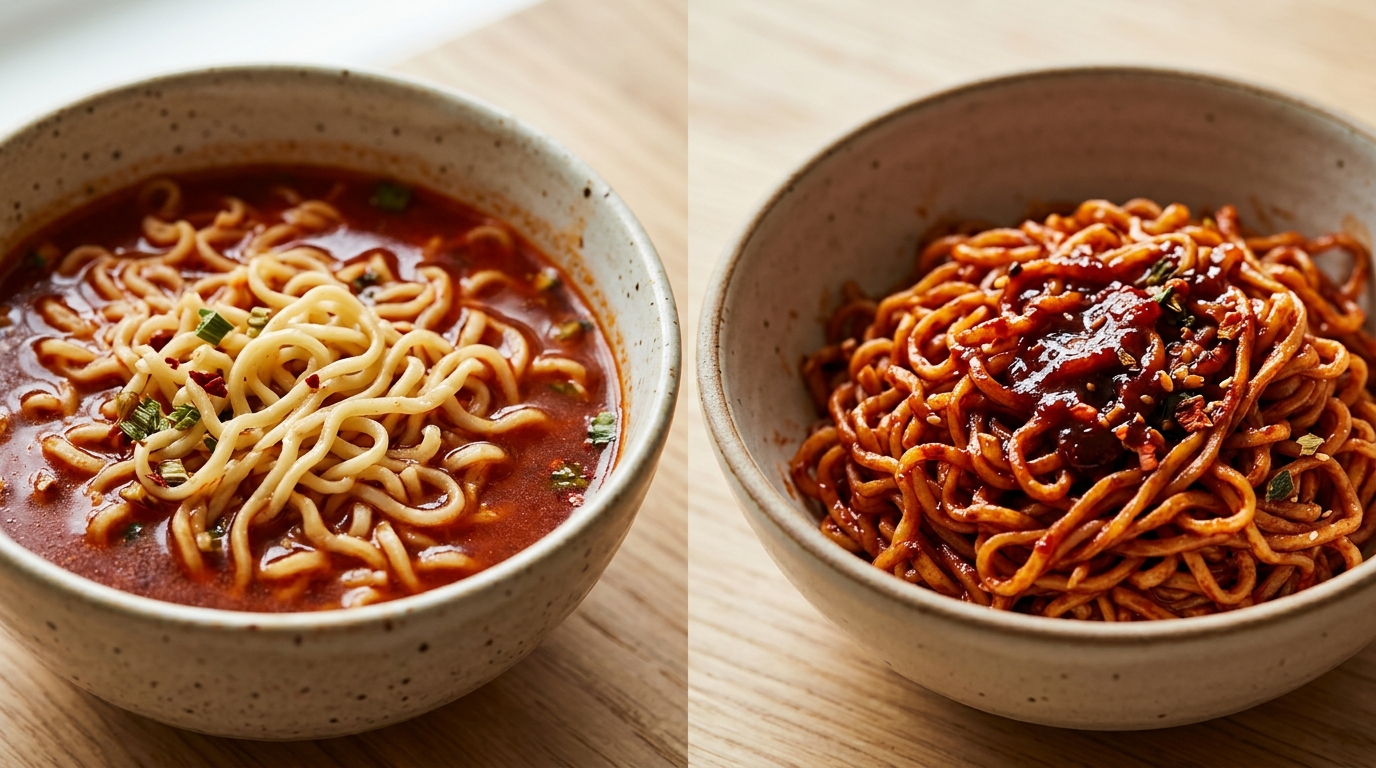
Korean instant noodles fall into two distinct consumption experiences. Soup-based ramyeon is the traditional standard, designed for a comforting, meal-in-a-bowl approach. These are intended to be cooked with specific ratios of water to maintain the integrity of the beef or vegetable-based broth. For many, the joy of ramyeon is the slurping of the hot, seasoned liquid, which often serves as a quick but satisfying meal during a busy workday. Broth-based noodles (left) vs. dry stir-fry noodles (right). · Illustrative AI image
Conversely, stir-fry noodles, or bokkeum-myeon, are prepared by boiling the noodles, draining the water, and coating them in a highly concentrated sauce. These noodles have a much higher viscosity and are significantly more intense in flavor and spice concentration. Confusing these two categories often leads to disappointment for beginners who expect a broth-based meal but receive an extremely concentrated spicy sauce. When shopping on Amazon, look for keywords like "Stir-fry," "Liquid Soup," or "Powder Soup" to determine the category. Soup noodles are meant to be a full, hydrating meal, while stir-fry noodles are designed as an intense, singular flavor experience. If you accidentally attempt to turn a stir-fry noodle into a soup, you will find the flavor profile thin and the texture of the noodles lack the necessary sauce adherence that makes them palatable.
Nongshim Shin Ramyun: The Gold Standard
Shin Ramyun is widely considered the benchmark for Korean spicy soup-based ramen [Nongshim Official Website]. Its flavor profile is defined by a deep, savory beef broth balanced with bold chili flakes and aromatic shiitake mushrooms. It is the "default" choice in many Korean households because of its reliable spice profile—it is spicy by Western standards, but within the mainstream spectrum for Korean daily consumption. The noodles are thick, chewy, and designed to withstand several minutes of boiling without turning mushy. When preparing Shin Ramyun, maintain the recommended water volume; adding too much water will dilute the base notes of the garlic and pepper. For those who find it slightly too intense, using the seasoning packet sparingly or adding vegetables can help modulate the heat. The longevity of this brand in the market is testament to its consistency; whether you are a novice or a seasoned eater, it remains the standard by which all other spicy beef-base noodles are measured in local grocery stores.
Ottogi Jin Ramen: The Balanced Comfort Choice
Ottogi is the primary competitor to Nongshim, and their Jin Ramen series is celebrated for its versatility [Ottogi Official Website]. Unlike some brands that only offer a one-size-fits-all spice level, Jin Ramen offers distinct "Mild" and "Spicy" versions. This makes it an ideal entry point for travelers or buyers who want to experience the chewy, thick Korean noodle texture without being overwhelmed by intense heat. The "Mild" version preserves the classic beef-vegetable base flavor without the addition of heavy chili oil or extra pepper powder, making it a reliable staple for children or those with a low tolerance for capsaicin. The "Spicy" version provides a punchy, energetic flavor that is perfect for those who want a classic Korean ramyeon experience that is slightly more accessible than the high-intensity heat profiles of other market leaders. When choosing between Mild and Spicy, consider that the base broth is identical; the difference lies solely in the red pepper seasoning packet, giving you full control over your final bowl.
Samyang Buldak Carbonara: The Viral Stir-fry Experience
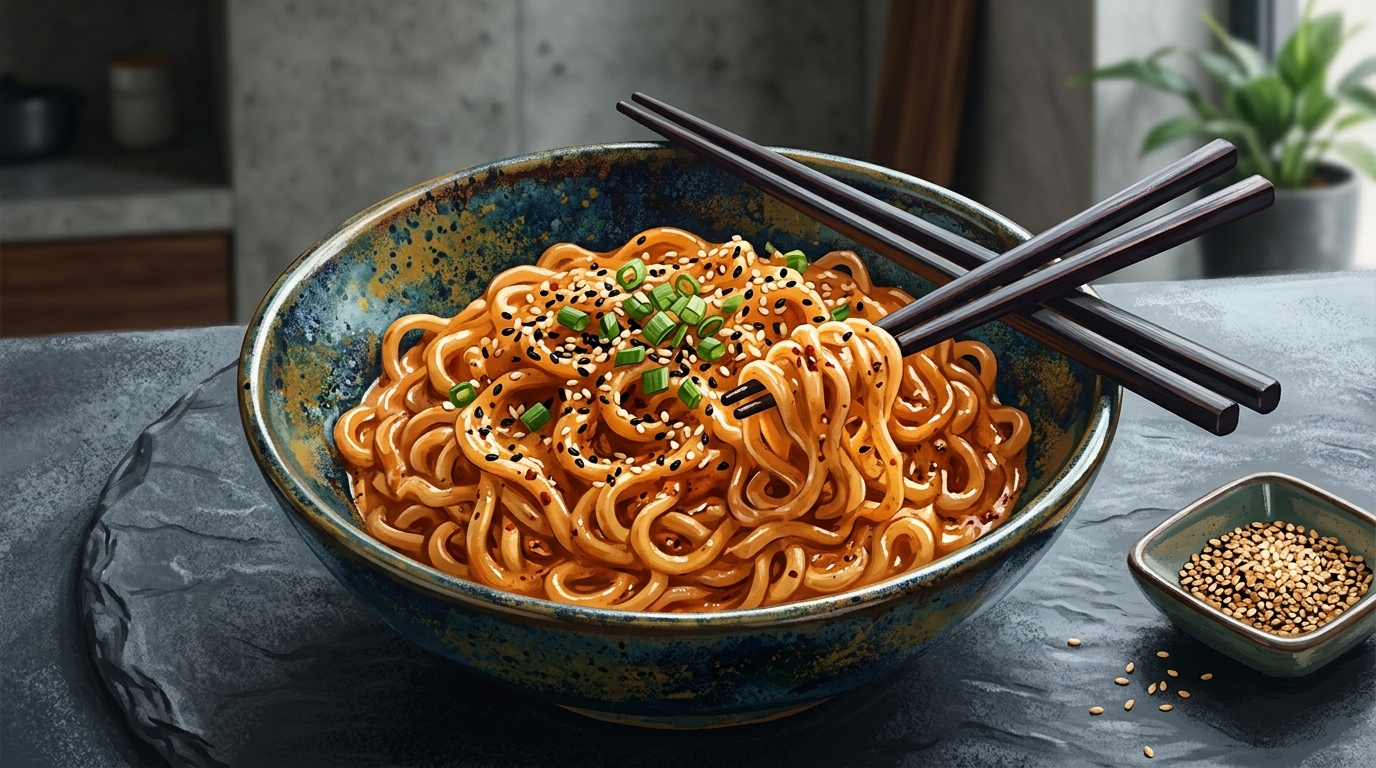
Samyang’s Buldak series, particularly the Carbonara flavor, represents the modern "challenge" trend in Korean food culture. Unlike the soup-based options, the Buldak line is purely a stir-fry style. The Carbonara version is specifically designed to provide the signature Samyang spice while tempering it with a creamy, cheese-based sauce powder. It is not designed to be eaten as a soup; attempting to add excess water will compromise the intended texture and dilute the creamy sauce. Stir-fry noodles are meant to be tossed in a concentrated sauce, not boiled in excess water. · Illustrative AI image
The key to success with Buldak is the preparation: leave about 5–8 tablespoons of water in the pan after boiling the noodles, add the sauce, and toss over low heat until the liquid reduces into a thick, glossy coat. The Carbonara flavor has gained massive international popularity precisely because it bridges the gap between the "extreme heat" trend and a palatable, creamy flavor profile, making it a gateway product for many who were initially hesitant about trying spicy Korean noodles. It is crucial to remember that Buldak noodles are significantly higher in calories and sodium density compared to broth-based ramyeon, reflecting their status as a specialized flavor experience rather than a daily sustenance staple.
Buyer's Guide: Spice Tolerance & Usage
When selecting your noodles on Amazon, categorize them by your heat tolerance and your desired meal type. Using our guide to navigate the vast selection available online will ensure you get a product that fits your pantry needs. Use this scale to identify which ramen fits your heat tolerance. · Illustrative AI image
Product
Type
Heat Level
Best For
Jin Ramen (Mild)
Soup
Low
Beginners
Shin Ramyun
Soup
Medium-High
Classic Fans
Buldak Carbonara
Dry
High (Creamy)
Trend Seekers
Always verify the "Multi-pack" options on Amazon, as flavor profiles between single packs and bulk boxes remain consistent. When buying, check for the original Korean packaging versus exported versions, as the latter sometimes have lower sodium or different dehydration processes. Always ensure you are buying the intended noodle style to avoid improper preparation methods. Using the wrong technique—such as draining soup noodles—will result in an incredibly salty, unpalatable experience. Check the back of the packaging for the "water amount" in milliliters; precision is what makes these noodles consistent. If you are ordering for the first time, start with a 5-pack rather than a bulk carton to ensure the specific spice level suits your personal palate.
Upgrade Your Ramen Like a Local
In Korea, convenience store employees and residents rarely eat ramen exactly as it comes out of the package. Adding ingredients is standard practice to balance the sodium and spice. For broth-based noodles like Shin Ramyun, adding a slice of processed cheese creates a richer, smoother broth. For all types, a soft-boiled egg adds protein and acts as a buffer against the heat of the chili oils. Simple upgrades like eggs and cheese are the standard way to enjoy ramen in Korea. · Illustrative AI image
Other traditional upgrades include adding fresh scallions, minced garlic, or even a handful of bean sprouts to add crunch and fresh flavor to the salty broth. If you are preparing your noodles at home, experimenting with these simple additions is the fastest way to customize your dining experience. For more on how to navigate the local food scene, check out our guide on must-have apps for Korea to help locate local grocery stores. If you need help managing your purchases while traveling, consider reading our guide on Seoul subway luggage storage to keep your hands free while hunting for the best snacks. These additions are not just culinary preferences; they are practical ways to turn a singular snack into a nutritionally rounded meal that can sustain you through a long day of sightseeing or work.
Frequently Asked Questions
Is Buldak ramen just for the spicy challenge?
While the original Buldak line gained fame for the "Fire Noodle Challenge," the Carbonara and Cheese versions are balanced with creamy ingredients, making them more approachable. They provide a unique blend of high spice and rich texture that isn't just about heat, but flavor complexity. Many locals use these as a base to mix with other ingredients like sausages or cabbage to mellow the intensity, transforming it from a dare into a genuine culinary option.
What is the difference between Jin Ramen Mild and Spicy?
The difference is strictly in the chili concentration. The Mild version is designed for those who want the classic savory beef-vegetable broth without the aggressive spicy finish. The Spicy version contains a higher concentration of red chili powder in the seasoning packet. Both maintain the same noodle structure and aromatic quality that have made Ottogi a staple in Korean households.
Can I add cheese to Shin Ramyun?
Yes, it is a common way to eat it in Korea. Adding a slice of American-style processed cheese into the boiling broth while the noodles are finishing provides a rich, mellow flavor that effectively balances the spice, creating a creamy contrast to the sharp chili base. This technique is often referred to in Korea as "Cheese Ramen" and can be found on the menu of many casual noodle shops.
Which ramen is best for someone who cannot eat spicy food?
Jin Ramen Mild is the safest entry point. It captures the essential texture and flavor profile of a classic Korean meal without the burning spice intensity associated with Shin Ramyun or Buldak, providing a gentle introduction to the category. If even this is too much, reducing the amount of seasoning powder used in the water is a common trick used by those sensitive to salt and heat.
How do I know if I'm buying the right type of ramen?
Always look for the preparation instructions on the back of the package. If it mentions "draining water" or "stir-frying," it is a dry noodle. If it gives a specific milliliter measurement for water, it is a soup noodle. Checking the Amazon product images for these details before purchasing is the most reliable way to avoid the wrong style. Additionally, verify that the packaging language is in Korean, as localized versions for other markets may have altered recipes to comply with different food safety standards or local tastes.
Final Checklist for Buying Korean Ramen
Check the packaging for the "Soup" vs. "Stir-fry" distinction before adding to cart.
Ensure your chosen spice level matches your tolerance—start with Mild if unsure.
Verify if the product is an international export or original Korean version, as these can vary slightly.
Prepare extra toppings like cheese, eggs, or scallions for a balanced, local-style meal.
Measure your water precisely using the milliliter guidelines on the packet to ensure the broth density is correct.
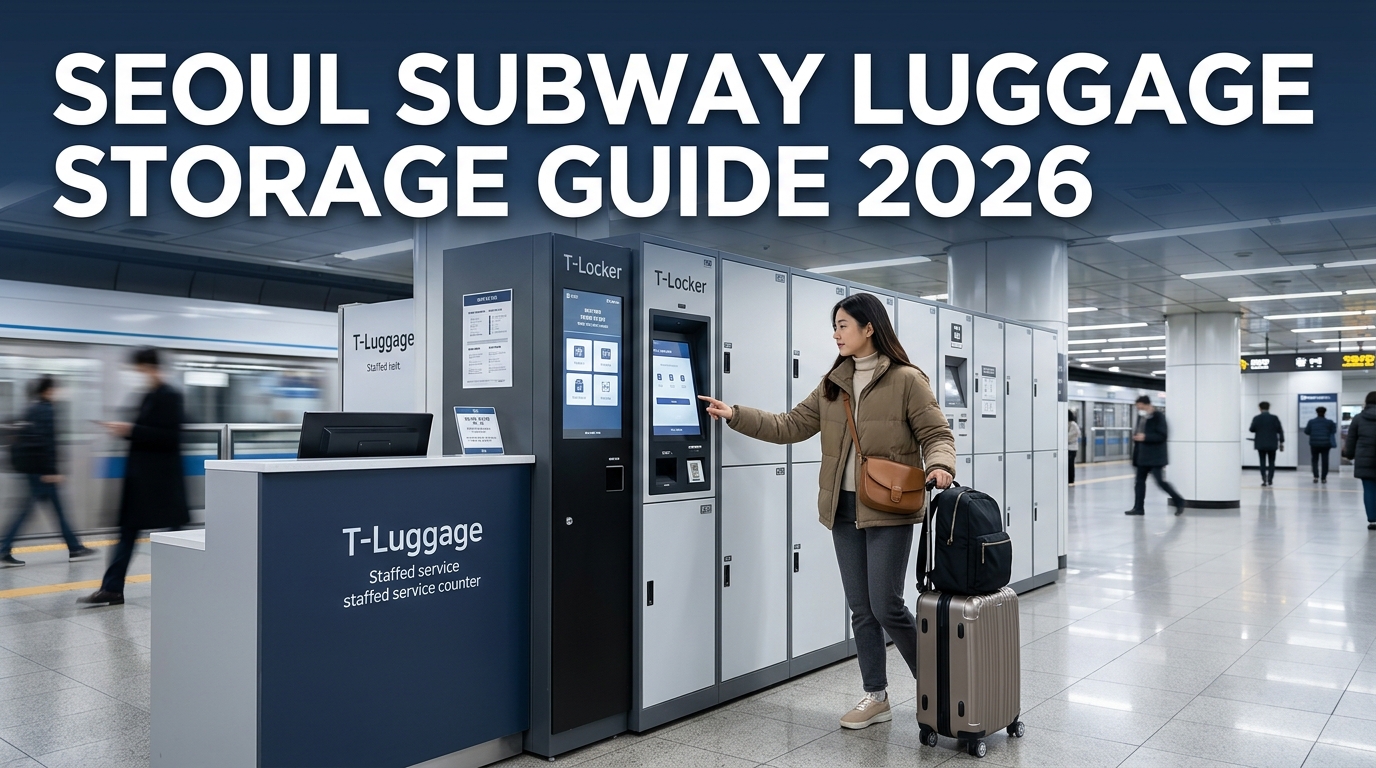
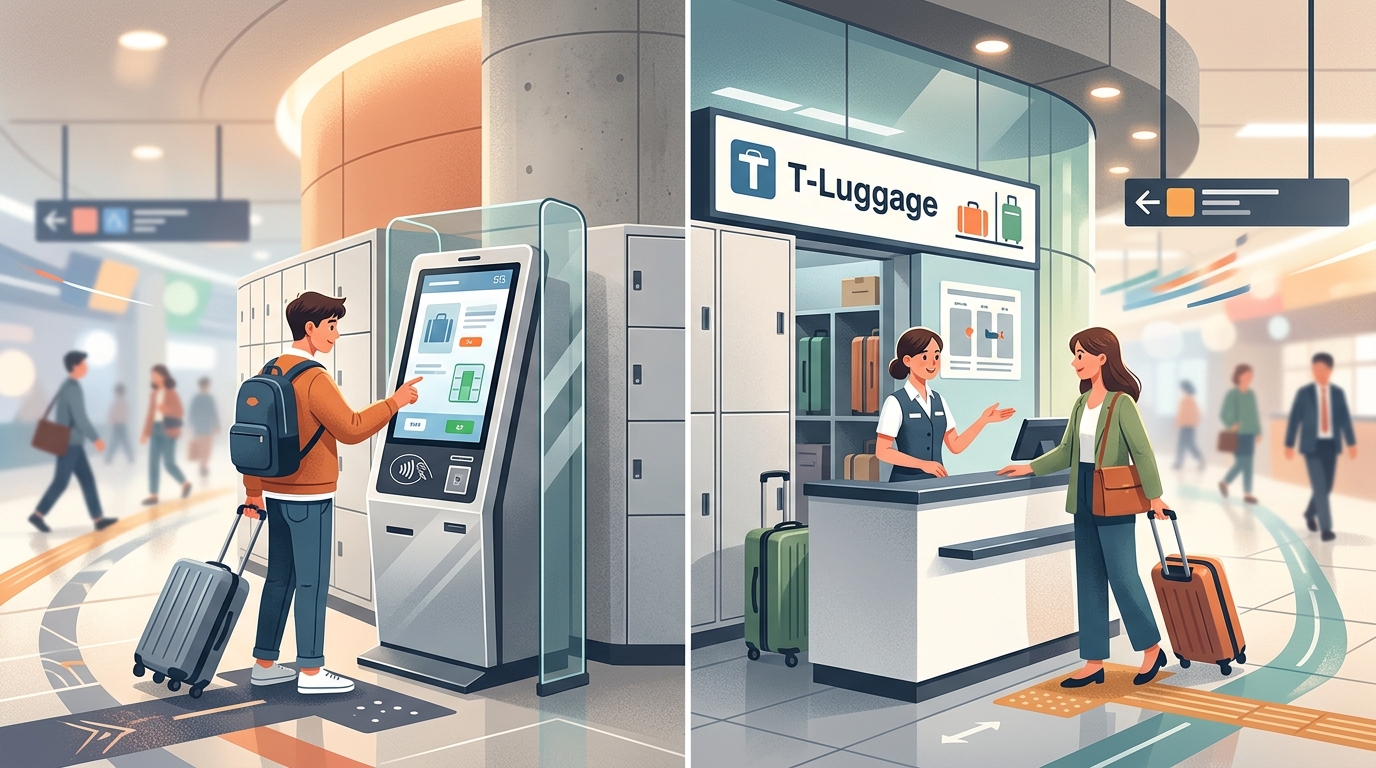
Navigating Seoul's transit is easier when you drop your bags at a locker. · Illustrative AI image
Researched in Korea — We check Korean-language local sources and direct official information, then explain the practical details in clear English.
Direct Answer: If you are looking to store your luggage in Seoul, the most efficient method is using the T-Locker system for self-service lockers or T-Luggage for staffed centers. Both are integrated into the Seoul Metro network, allowing you to drop off your bags and explore the city hands-free between hotel check-outs and flight departures.
A good storage plan starts with your return route, not with the first empty locker you see. Choose a station that you will naturally pass again before checking in, boarding a train, or heading to the airport. That small decision can prevent an unnecessary cross-city trip at the end of a long day. If your plans include outdoor walking during Korea’s summer rain season, review our practical monsoon travel guide before deciding how long to leave your bags.
Editor's take: My recommendation is to prioritize T-Luggage centers at major transit hubs (like Seoul Station) if you have oversized luggage or require same-day delivery services to Incheon Airport. For standard day-trips, the ubiquitous T-Locker banks found at over 270 stations provide the best balance of flexibility and cost.
The 'Drop & Roam' Strategy: Why Subway Storage is a Travel Hack
When this strategy saves the most time
Subway luggage storage is most useful on transition days: after an early arrival, before a late departure, or when a hotel cannot hold bags at a convenient time. Write down three points before choosing a locker: where you enter the rail network, where you will spend the day, and where you must be afterward. The best storage station is normally the one that fits that sequence with the least backtracking, even when another station appears closer on a map.
Treat the locker as part of your itinerary. Estimate when you will return, then add a comfortable buffer for finding the correct concourse and retrieving the bag. Seoul stations can have multiple exits and long internal passages, so a rushed pickup can erase the time you saved earlier. If the day’s route remains uncertain, choose a major transfer point that you expect to pass again rather than a one-purpose stop far from your final connection.
Dragging heavy suitcases through crowded subway platforms is the quickest way to exhaust yourself. Seoul’s transit infrastructure is designed to facilitate mobility, and utilizing designated luggage storage turns your transit hub into a temporary basecamp. By leaving your bags behind, you reclaim your mobility to explore neighborhoods like Myeong-dong or Hongdae without the logistical burden of heavy luggage.
T-Locker vs. T-Luggage Comparison
Choose the service by the problem you need to solve
A self-service locker suits travelers who have a bag that clearly fits, understand the payment and retrieval instructions, and want flexibility without speaking to staff. A staffed service is the safer choice when the luggage is unusually large, several bags must stay together, or you want help confirming the collection procedure. Neither option is automatically better; the right choice depends on bag size, the support you need, and how strictly your pickup time is fixed.
Before committing, confirm four things on the official screen, app, or service notice: the exact location, the available size, the fee and overtime rule, and the retrieval deadline. Do not assume that two stations use identical equipment or rules. If a key detail is unclear, use a staffed counter or another verified location rather than guessing with a bag already inside the system.
Feature
T-Locker
T-Luggage
Service Type
Automated/Self-Service
Staffed/Concierge
Best For
Quick, short-term storage
Oversized bags & airport delivery
Availability
270+ Stations
Major Transit Hubs (e.g., Seoul Stn)
Choose between automated lockers or staffed centers based on your luggage size. · Illustrative AI image
Where to Find Them: Locating Lockers in Seoul Subway Stations
Make the station layout part of your route
Knowing the station name is not enough. A locker may be outside the paid area, near a specific exit, or on a concourse that is inconvenient from the platform you use. When you find the storage point, note the exit number, floor, nearby sign, and whether you crossed a ticket gate. Save a photo or short note on your phone so you can return directly without repeating the search.
Availability can change during the day, especially at useful transfer locations. Build one backup into the same travel corridor before you arrive. A good backup is not simply the nearest station; it is a station that still works with your next destination and final departure route. This keeps a full locker bank from forcing a complete rewrite of the day.
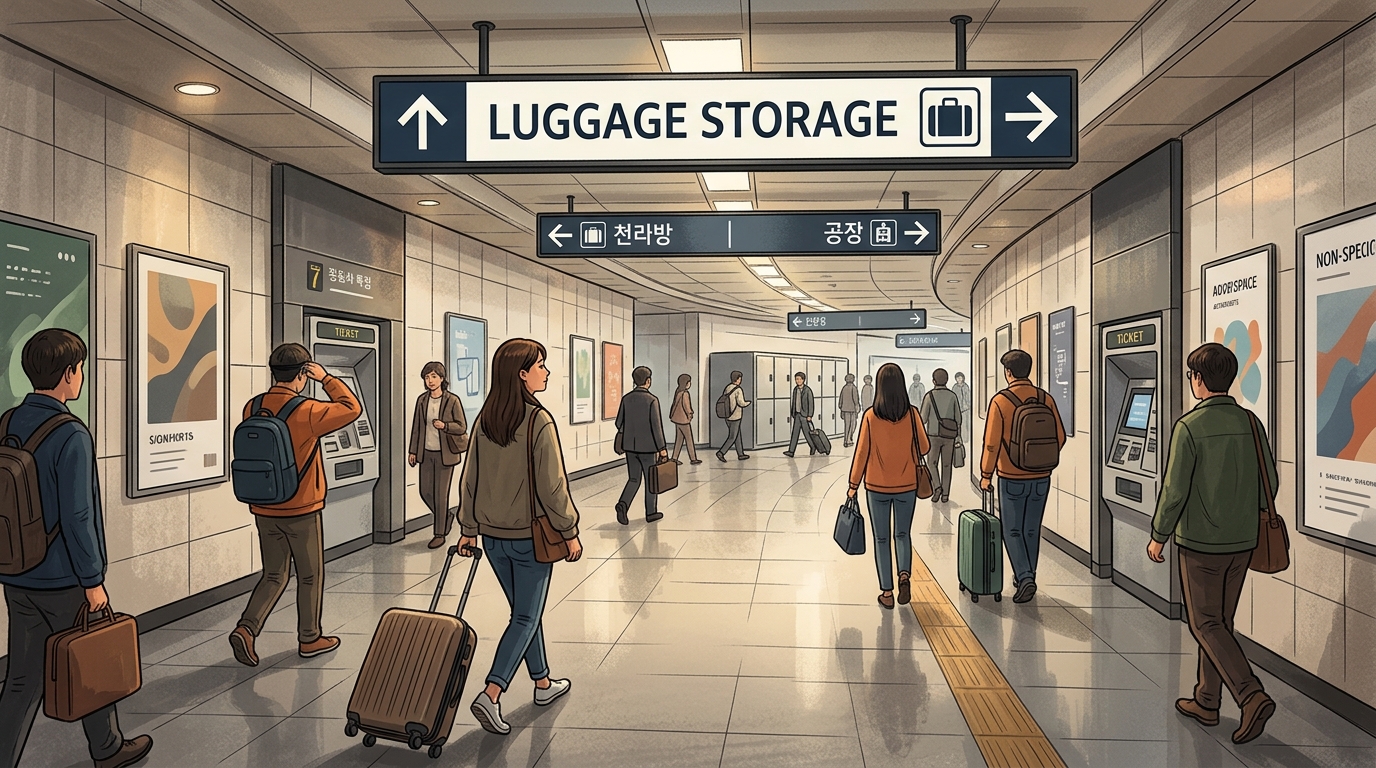
Locker banks are typically located near the ticket gates or in the concourse level of major subway stations. While almost all major stations have T-Locker facilities, the availability of T-Luggage is limited to high-traffic hubs such as Seoul Station. Always look for signage in English that says "Luggage Storage" or "Locker." You can verify real-time station amenities via the official Seoul Metro website.
Look for clearly marked 'Luggage Storage' signs near station concourses. · Illustrative AI image
How to Use T-Locker: Step-by-Step for Foreign Travelers
Complete a final check before you walk away
Read the confirmation screen slowly and verify that it refers to the station and locker you are standing beside. Save the locker number, transaction reference, access method, and any retrieval deadline in more than one place—for example, in the app and as a screenshot. If the system provides a receipt, keep it until the bag is back in your hands.
After closing the door, check that it is actually locked and that nothing is trapped around the edge. Set a phone reminder well before your intended pickup time. The reminder should account for subway travel, transfers, walking inside the station, and a small problem-solving buffer. This is especially important when the next step is a reserved train, airport transfer, or hotel check-in with a fixed closing time.
The T-Locker app simplifies the process for international visitors. Before you arrive, it is helpful to have your logistics planned; you can read more about essential tools in our guide to Navigating Korea: 5 Must-Have Apps for Your 2026 Trip.
Download & Register: Use the official T-Locker app.
Select Station: Choose your current subway station on the digital map.
Select Locker Size: Choose between small, medium, large, or extra-large to fit your bag.
Payment: Use a registered credit card or, in some cases, your T-money card balance as detailed on the official T-money website.
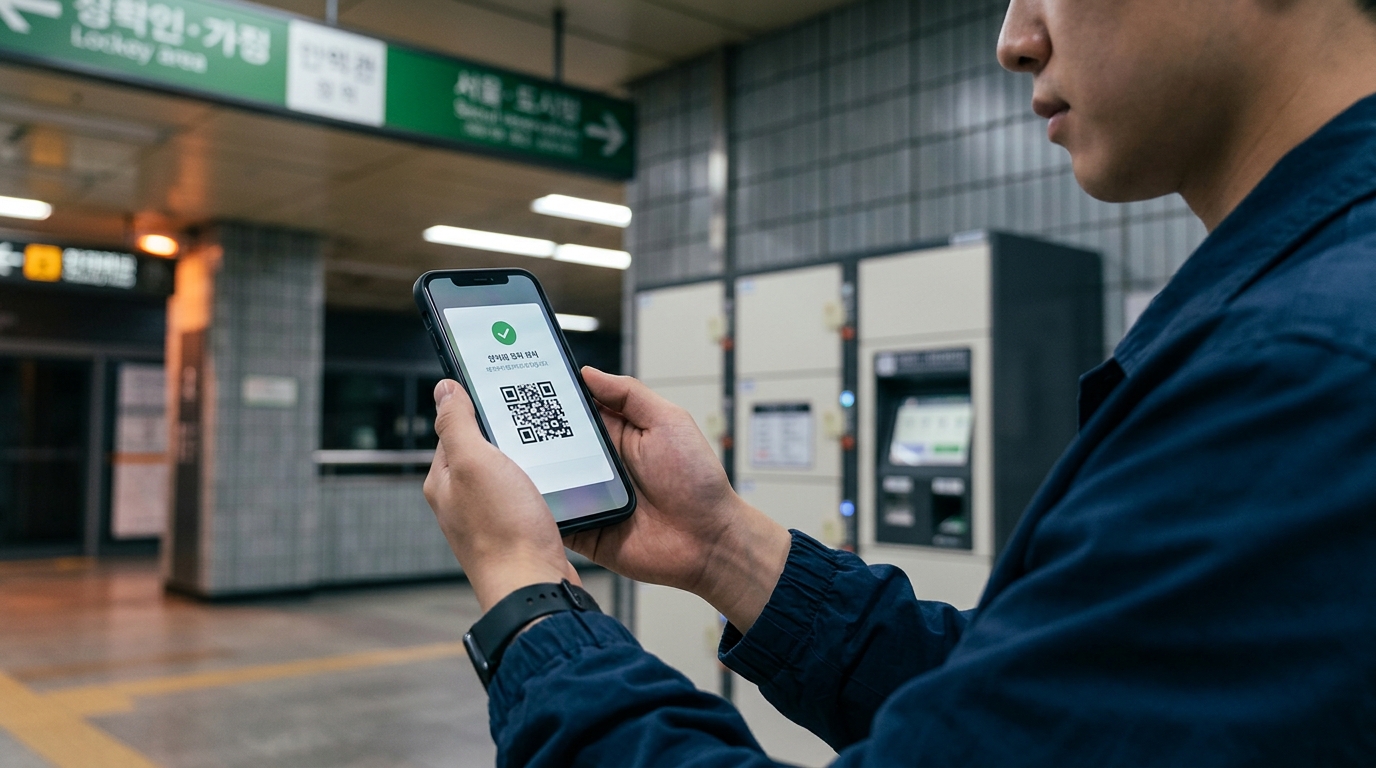
Secure: Follow the on-screen instructions to lock your bay and receive your access code or QR scan data.
The official app provides a seamless way to reserve your locker space. · Illustrative AI image
Budgeting and Payments
Compare the total journey cost, not only the posted fee
The lowest storage price is not always the cheapest decision. A locker that requires an extra round trip can add transit fares, walking, and lost sightseeing time. Compare the posted storage terms with the practical cost of returning to that station. When two locations appear similar, favor the one already on your departure path.
Before payment, read the current base period, overtime calculation, and overnight rule shown by the service. Do not rely on an old blog screenshot or a remembered price because equipment and policies can change. Note the start time and set an alert before the next charging period when the displayed terms make that useful. If the likely pickup time is uncertain, budget for the longer stay instead of planning around the minimum fee.
Storage fees are generally structured based on a base-time period, often a 4-hour window, followed by additional charges for exceeding that time. It is significantly cheaper to use these public facilities than private luggage storage shops. Remember that overnight storage usually incurs a higher cumulative fee, so plan your pickup time carefully.
Common Mistakes to Avoid
Plan retrieval as carefully as a train connection
The most common planning error is focusing on drop-off and treating pickup as automatic. Before leaving, open your map and confirm the route back to the same station. Check which entrance remains convenient from your evening location and whether your planned return leaves enough time for wayfinding. Keep passports, essential medicine, tickets, irreplaceable electronics, and anything needed before pickup with you rather than inside stored luggage.
If your phone controls access, protect the retrieval information from a dead battery or lost connection. Carry a charged power bank and save the essential reference offline when the service permits it. When sharing one locker with another traveler, make sure both people know the station, location, and pickup plan. A clear shared note prevents one person from leaving the area with the only access information.
Avoid leaving valuables like passports or cash in lockers; while the system is secure, common travel sense applies. Also, verify that the locker is fully latched before walking away, as some automated systems require a firm push to engage the locking mechanism.
Final Travel Checklist
A 60-second check before leaving the locker area
Confirm the station name, exit or concourse, locker number, and retrieval method.
Save the transaction or access reference offline and keep any receipt.
Set a pickup reminder that includes subway travel and walking time.
Keep essential documents, medicine, tickets, and valuables with you.
Tell companions exactly where the bag is stored and who will retrieve it.
Check your station of arrival for "Locker" signage on the metro map.
Ensure your phone is charged to access the T-Locker app for retrieval.
Keep your locker access code or QR code screenshot saved in your photos.
Carry a backup payment method if your T-money balance is low.
Frequently Asked Questions
Can I use subway lockers if I don't have a Korean phone number?
Yes, the modern T-Locker app systems are designed to support international travelers. Ensure your app is updated to the latest 2026 version for seamless registration.
How do I pay if I only have a credit card?
Most digital T-Locker systems accept international credit cards via the app payment gateway. For staffed T-Luggage centers, credit cards are standard practice.
Are there size limits for T-Locker lockers?
Lockers are categorized by size. Always choose the size that accommodates your bag with a little room to spare. If your bag is exceptionally large, prioritize finding a T-Luggage staffed center.
Can I leave my luggage overnight?
Yes, but be aware that extra fees apply for every 24-hour cycle. Check the app for the specific overtime policy before locking your items.
Freeing your hands allows you to move through Seoul's stations with ease. · Illustrative AI image
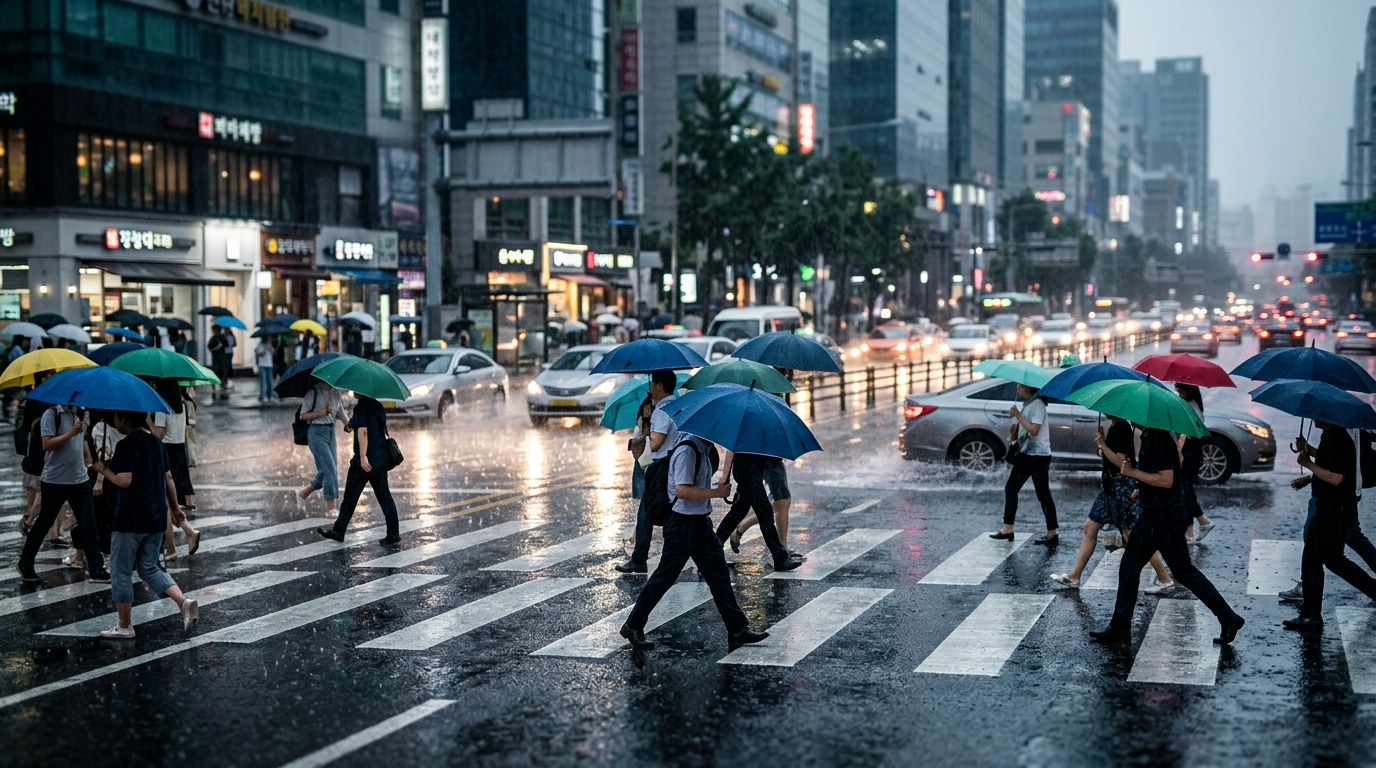
Navigating the vibrant streets of Seoul during the rainy season. · Wikimedia Commons (Atlas AI image pipeline · AI-generated editorial image)
Key Takeaways
Planning a trip to Korea in July or August? You are likely arriving during the Jangma, or monsoon season. While the rain can be intense, it rarely lasts all day. By staying informed through official channels and having a flexible itinerary, you can still have a fantastic experience.
What to Expect: Understanding the Monsoon
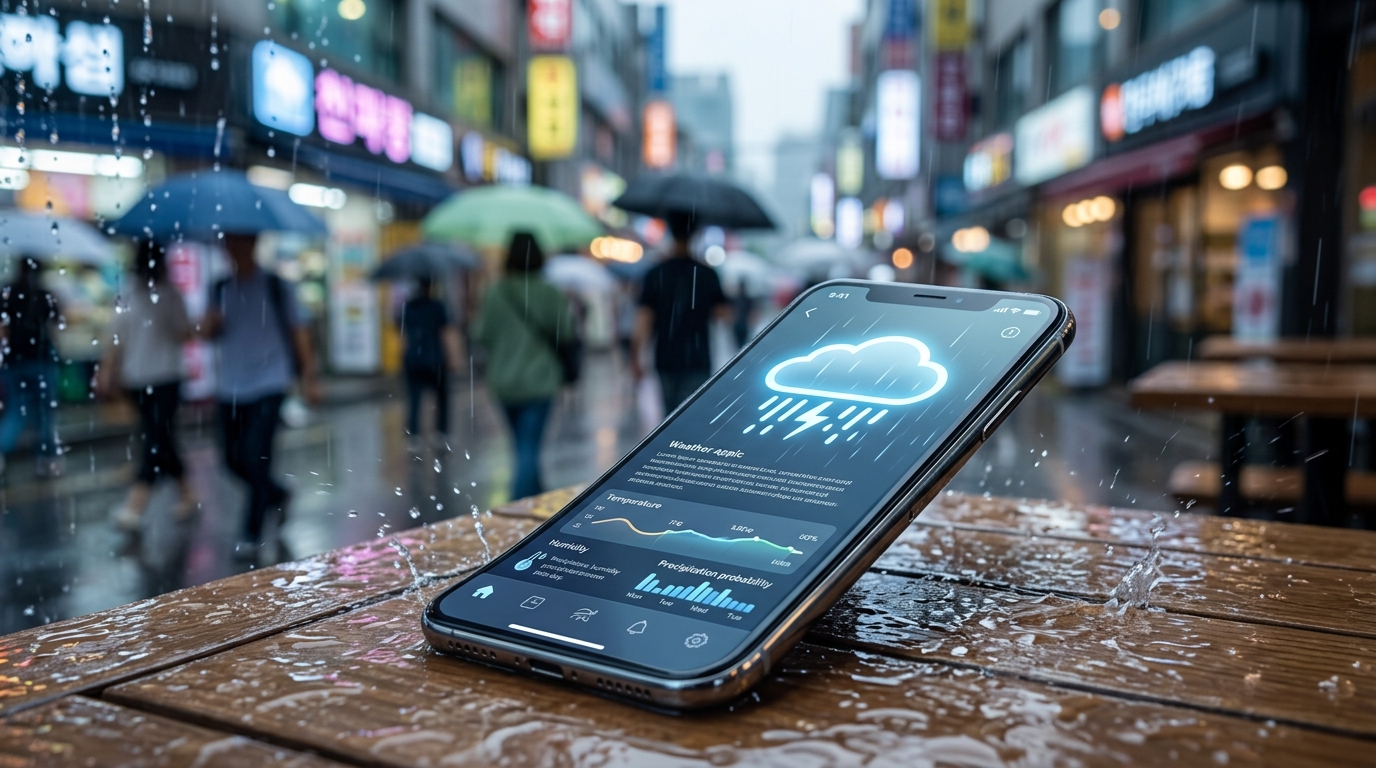
Always check official weather apps before heading out. · Wikimedia Commons (Atlas AI image pipeline · AI-generated editorial image)
The Korean monsoon is characterized by a stationary front that brings periods of heavy, localized rainfall. Unlike a tropical storm that might wash out an entire week, Jangma often presents as intense, short-lived downpours followed by humid, overcast, or even sunny spells. In 2026, the season began in early July, and travelers should be prepared for potential rain through early August.
Safety First: Staying Informed
Seoul's large malls are perfect for staying dry. · Wikimedia Commons (Atlas AI image pipeline · AI-generated editorial image)
Safety is the priority when traveling during the rainy season. Heavy rainfall can lead to localized flooding or the temporary closure of riverside parks and hiking trails. Always monitor the Korea Meteorological Administration (KMA) for the latest alerts. If you receive an emergency alert on your mobile phone, take it seriously and follow the instructions provided by local authorities.
Editor's take: Don't let the word 'monsoon' scare you off. The most successful travelers in Korea during this time are those who treat their itinerary like a 'choose-your-own-adventure' book—keep your indoor options ready and pivot when the sky turns dark.
The 'Rainy Day' Itinerary
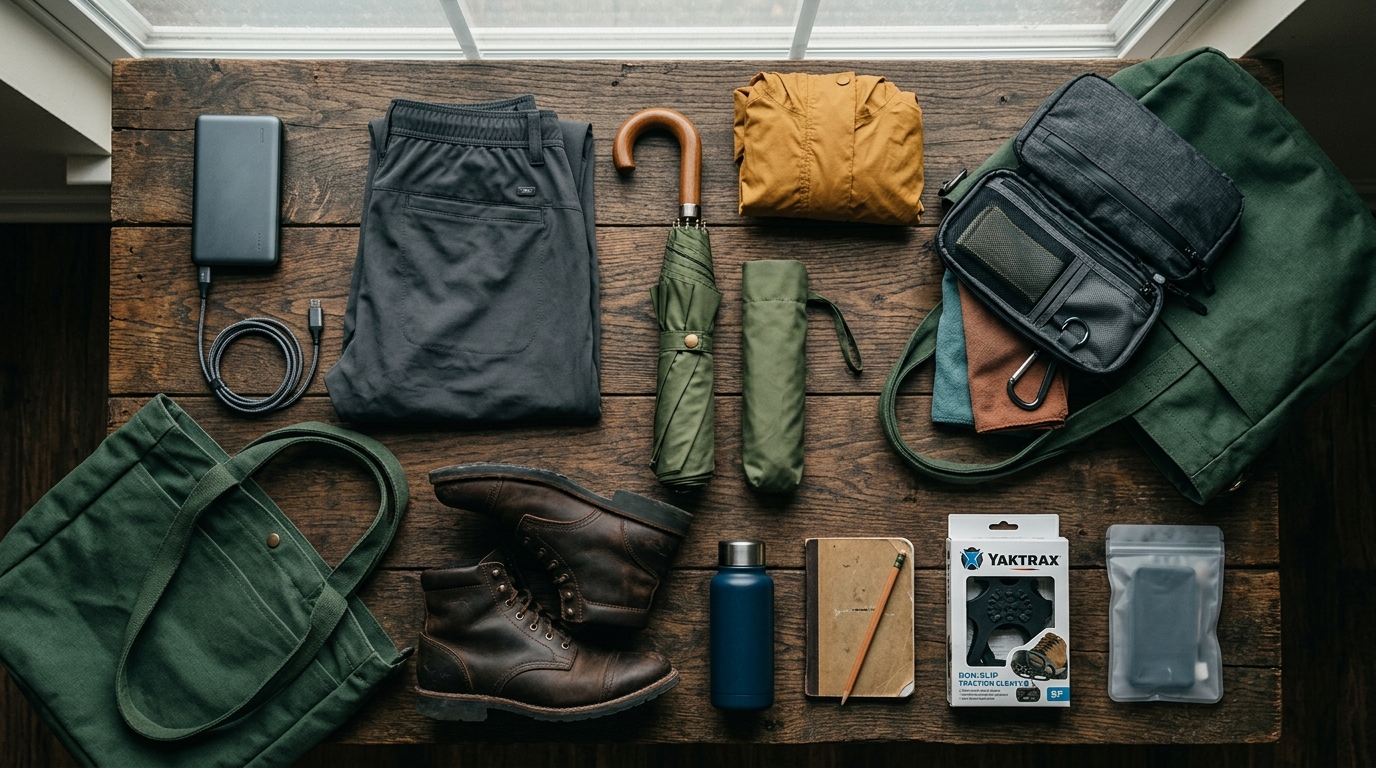
Pack light, breathable gear for humid rainy days. · Wikimedia Commons (Atlas AI image pipeline · AI-generated editorial image)
When the rain is too heavy for walking tours, Seoul offers world-class indoor alternatives. The COEX Mall in Gangnam is a sprawling underground complex that allows you to spend an entire day shopping, dining, and visiting the Starfield Library without ever needing an umbrella. Additionally, major museums like the National Museum of Korea provide deep dives into history while keeping you perfectly dry.
Practical Survival Tips
Preparation is key to comfort. Carry a sturdy, wind-resistant umbrella, as gusts can be strong during downpours. Wear breathable, quick-drying clothing to combat the high humidity. Most importantly, use Naver Map for real-time public transportation updates. It is the most accurate tool for checking if specific bus routes or subway lines are experiencing delays due to weather conditions.
Common Mistakes to Avoid
One common mistake is over-planning outdoor activities for every single day. If you book a hiking tour or an outdoor photography session, ensure you have a backup indoor reservation. Another error is failing to waterproof your electronics; even if you have an umbrella, the sheer volume of rain in Korea can lead to humidity damage or accidental splashes.
Final Rainy Season Checklist
Download Naver Map for real-time transit and weather alerts.
Pack a compact, wind-resistant umbrella.
Bring a light, waterproof jacket or poncho.
Carry a portable power bank (heavy rain can drain phone batteries faster).
Keep a list of 3-4 indoor museums or malls as 'Plan B' options.
Frequently Asked Questions
Does it rain all day during the monsoon season?
No. The Korean monsoon (Jangma) typically consists of intermittent, heavy downpours rather than constant rain. You will often experience breaks in the weather.
Is public transportation affected by the rain?
Public transport in Korea is highly reliable. However, during extreme weather, some riverside paths or hiking trails may be closed for safety. Always check Naver Map for real-time updates.
What should I do if I receive an emergency alert?
Emergency alerts are sent to all mobile devices in the area. If you receive one, follow the instructions provided, which may include avoiding low-lying areas or staying indoors.
Are indoor activities better for rainy days?
Yes. Seoul has excellent indoor options like the COEX Mall, Lotte World, and various national museums that are fully equipped to provide a great experience regardless of the weather outside.
Frequently Asked Questions
Does it rain all day during the monsoon season?
No. The Korean monsoon (Jangma) typically consists of intermittent, heavy downpours rather than constant rain. You will often experience breaks in the weather.
Is public transportation affected by the rain?
Public transport in Korea is highly reliable. However, during extreme weather, some riverside paths or hiking trails may be closed for safety. Always check Naver Map for real-time updates.
What should I do if I receive an emergency alert?
Emergency alerts are sent to all mobile devices in the area. If you receive one, follow the instructions provided, which may include avoiding low-lying areas or staying indoors.
Are indoor activities better for rainy days?
Yes. Seoul has excellent indoor options like the COEX Mall, Lotte World, and various national museums that are fully equipped to provide a great experience regardless of the weather outside.
Get your digital tools ready before you land in Korea. · Wikimedia Commons (Atlas AI image pipeline · AI-generated editorial image)
Navigating Korea: 5 Must-Have Apps for Your 2026 Trip
Published: 2026-07-18 | Updated: 2026-07-18
Key Takeaways
Google Maps has limited functionality in Korea; local apps are essential for accurate transit and walking directions.
Naver Map is the gold standard for navigation, while KakaoMap is a strong alternative.
Papago is the most accurate translation tool for Korean cultural context and real-time text.
Kakao T is the primary app for hailing taxis, supporting international credit cards and 'pay to driver' options.
Always secure a stable mobile data connection (eSIM or roaming) before arrival to ensure these apps function correctly.
The 'Google Maps Problem' in Korea
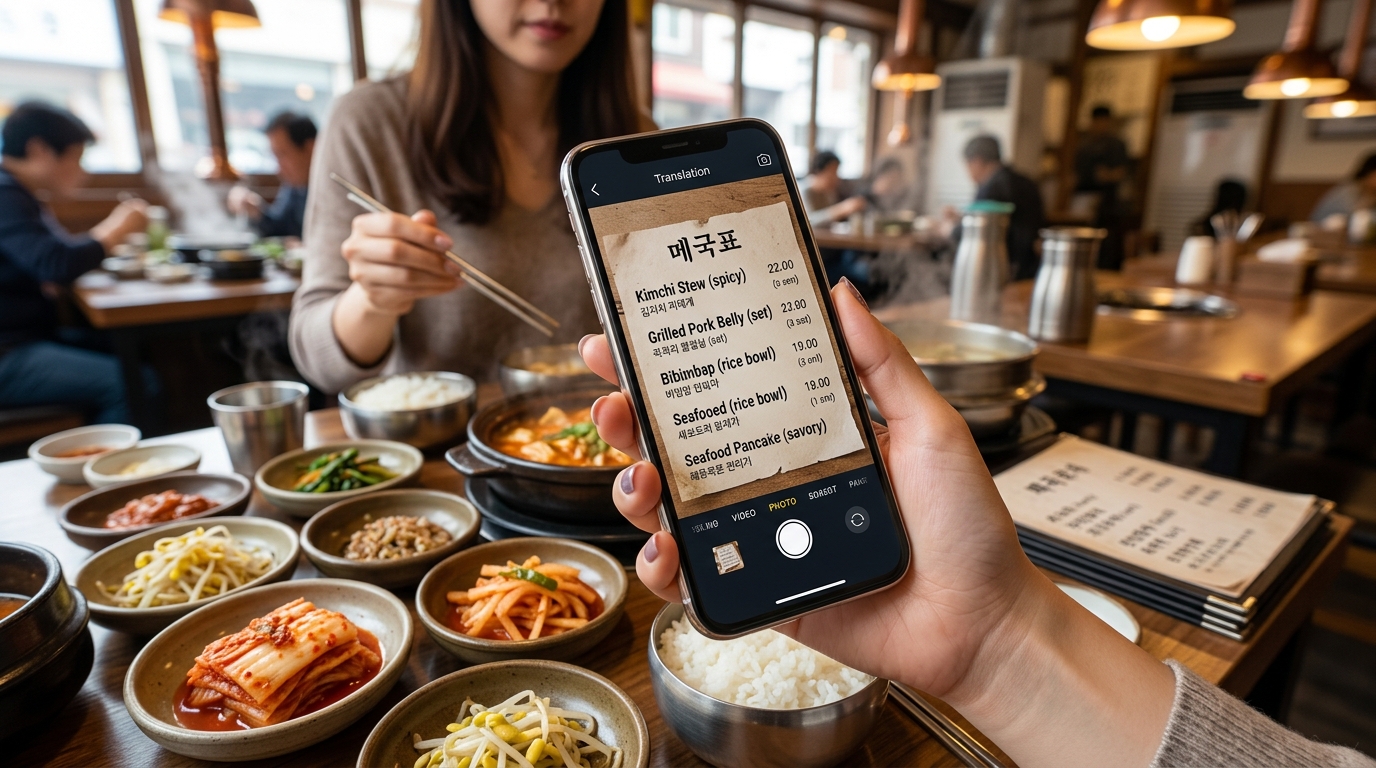
Papago helps bridge the language gap during your travels. · Wikimedia Commons (Atlas AI image pipeline · AI-generated editorial image)
Preparing for your first trip to South Korea? You might be surprised to find that the apps you rely on at home, such as Google Maps, often struggle to provide accurate walking or public transit directions in Korea due to local security regulations. This is not a technical glitch but a result of government restrictions on mapping data. For reliable routing, you must switch to local alternatives that have full access to the country’s transit infrastructure. For more official guidance on navigating the country, you can check the VISITKOREA Official App.
The Big 3: Navigation, Translation, and Transport
Hailing a taxi is simple with the right local app. · Wikimedia Commons (Atlas AI image pipeline · AI-generated editorial image)
To ensure a smooth trip, prioritize these three essential applications:
Naver Map: The most widely used navigation tool in Korea. It provides precise walking, bus, and subway directions in English.
Papago: Developed by Naver, this is the superior choice for translating Korean. It handles cultural nuances and informal speech much better than generic translators.
Kakao T: The standard app for hailing taxis. It is essential for getting around when public transport is not convenient.
Editor's take: While many tourists download multiple apps, I recommend focusing on mastering Naver Map and Papago first. These two will solve 90% of your daily navigation and communication hurdles.
Essential Preparation: Data and Setup
These apps require a reliable internet connection to function. Before you land, ensure you have an active eSIM or a roaming plan. Without mobile data, you will not be able to use real-time transit updates or translation features on the go.
Pro-Tips for Foreign Travelers
When using Kakao T, you may encounter payment hurdles. If your international credit card is not accepted, look for the 'Pay to Driver' option, which allows you to pay via cash or your own card directly to the taxi driver at the end of your trip.
Common Mistakes to Avoid
One of the biggest mistakes travelers make is waiting until they arrive at their hotel to set up these apps. Verification codes are often sent via SMS, so it is crucial to have your roaming active or your local SIM installed the moment you land at Incheon Airport. Additionally, don't rely solely on offline maps; Korea's transit system changes frequently, and real-time data is vital.
Frequently Asked Questions
Why does Google Maps not work in South Korea?
Due to national security regulations, detailed mapping data for Korea is restricted, limiting Google Maps' ability to provide walking and transit routes.
Is Naver Map or KakaoMap better for tourists?
Both are excellent, but Naver Map is generally considered the most reliable for English-speaking tourists due to its comprehensive business listings and transit accuracy.
Do I need a Korean bank account to use these apps?
No. While some advanced features may require local verification, the core navigation, translation, and taxi-hailing functions are accessible to international visitors using international cards or 'pay to driver' options.
Can I use Papago offline?
Papago offers some offline translation capabilities, but for the best accuracy and real-time image translation, a stable data connection is highly recommended.
Is Kakao T available in English?
Yes, the Kakao T app supports an English interface, making it accessible for international travelers to hail taxis and navigate the city.
Frequently Asked Questions
Why does Google Maps not work in South Korea?
Due to national security regulations, detailed mapping data for Korea is restricted, limiting Google Maps' ability to provide walking and transit routes.
Is Naver Map or KakaoMap better for tourists?
Both are excellent, but Naver Map is generally considered the most reliable for English-speaking tourists due to its comprehensive business listings and transit accuracy.
Do I need a Korean bank account to use these apps?
No. While some advanced features may require local verification, the core navigation, translation, and taxi-hailing functions are accessible to international visitors using international cards or 'pay to driver' options.
Can I use Papago offline?
Papago offers some offline translation capabilities, but for the best accuracy and real-time image translation, a stable data connection is highly recommended.
Is Kakao T available in English?
Yes, the Kakao T app supports an English interface, making it accessible for international travelers to hail taxis and navigate the city.
Navigating the rainy season in Seoul requires a mix of preparation and flexibility. · Wikimedia Commons (Atlas AI image pipeline · AI-generated editorial image)
Navigating the 2026 Monsoon Season in Korea
If you are visiting South Korea this July, you may have noticed the humid, rainy weather. The 2026 monsoon season, known locally as Jangma, began later than historical averages—starting in late June for Jeju and early July for the mainland. As of mid-July, central regions, including Seoul, are experiencing intermittent heavy rainfall and high humidity. While this weather can be disruptive, it does not have to ruin your trip. By staying informed and flexible, you can still enjoy the unique charm of Korea during the summer.
Essential Safety Protocols
Always check the KMA website for the latest weather alerts. · Wikimedia Commons (Atlas AI image pipeline · AI-generated editorial image)
Your safety is the top priority during the monsoon. Heavy rain can lead to localized flooding or landslide risks in mountainous areas. Always check official sources before heading out. The Korea Meteorological Administration (KMA) provides the most accurate, real-time weather forecasts and emergency alerts in English.
Monitor KMA Alerts: Stay updated via the official KMA portal.
Avoid Valleys and Rivers: During periods of heavy rain, avoid hiking in valleys or near riverbanks, as water levels can rise rapidly without warning.
Emergency SMS: If you have a local SIM or roaming, you may receive emergency alerts. These are official warnings; follow the guidance provided in them.
Transportation Resilience
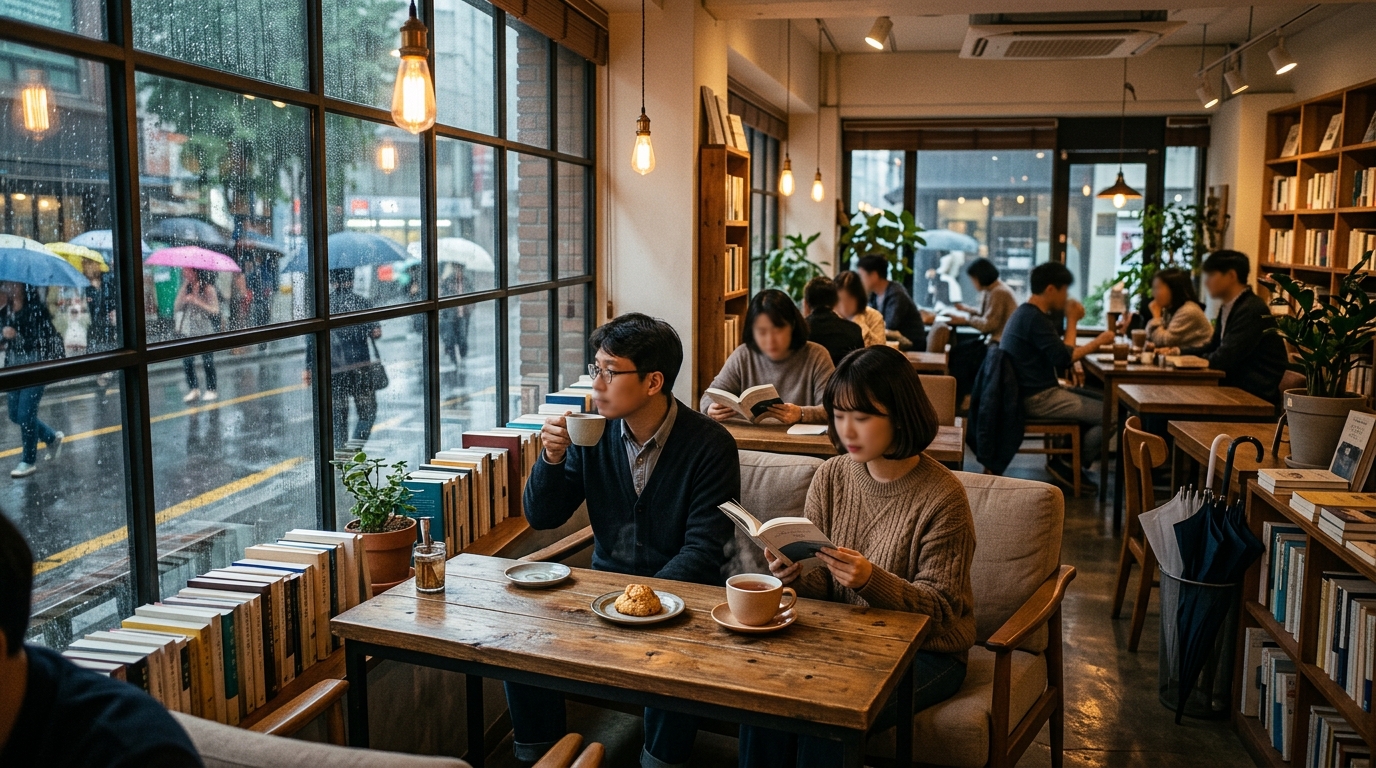
Seoul's café culture is the perfect escape from the monsoon rain. · Wikimedia Commons (Atlas AI image pipeline · AI-generated editorial image)
Public transportation in Seoul is generally robust, but heavy rain can cause delays. Avoid relying on taxis during peak downpours, as demand often exceeds supply. The subway remains your best bet for navigating the city efficiently.
Use Local Apps: Rely on Naver Map or KakaoMap rather than generic international map apps. These local platforms provide the most accurate, real-time status for subway lines and bus routes.
Subway vs. Bus: The Seoul subway system is the most reliable way to travel during heavy rain, as it remains largely unaffected by surface traffic and flooding.
Flexible Indoor Itineraries
The subway is the most reliable way to navigate Seoul during heavy rainfall. · Wikimedia Commons (Atlas AI image pipeline · AI-generated editorial image)
When the rain starts, shift your plans to indoor experiences. Seoul offers a wealth of culture that is perfectly suited for a rainy day:
Museums and Galleries: Spend the day at the National Museum of Korea or the various art galleries in Samcheong-dong.
Library Culture: Visit iconic indoor spaces like the Starfield Library in COEX Mall, which offers a stunning, dry environment for reading and relaxing.
Café Hopping: Korea’s café culture is world-class. Use the rain as an excuse to explore themed cafés in neighborhoods like Seongsu-dong or Ikseon-dong.
Editor's take: Don't try to force an outdoor itinerary when the KMA issues a heavy rain warning. Embrace the 'rainy day' aesthetic of Seoul—the city looks beautiful under the mist, and it is the perfect time to experience the local café scene at a slower pace.
Packing for Humidity and Rain
Humidity is the silent challenge of a Korean July. Pack lightweight, quick-dry fabrics rather than heavy denim. A sturdy, wind-resistant umbrella is essential, though you can easily purchase high-quality ones at any convenience store (like GS25 or CU) if yours breaks. Consider bringing a small hand-held fan, which is a staple for locals navigating the humid subway stations.
Common Monsoon Mistakes
Many travelers make the mistake of ignoring localized flood warnings or assuming that all outdoor tourist sites operate as normal. Another frequent error is wearing non-breathable footwear, which can lead to discomfort during high-humidity days. Always prioritize waterproof, comfortable walking shoes. Do not underestimate the intensity of the rain; even short walks can result in soaked clothing if you are not prepared with proper rain gear.
Final Travel Checklist
Download Naver Map or KakaoMap.
Bookmark the KMA English website.
Pack a lightweight, quick-dry rain jacket.
Keep a portable power bank for your phone (essential for checking maps).
Have a 'Plan B' indoor activity ready for every outdoor day.
Carry a small waterproof bag for your electronics.
Frequently Asked Questions
Is it safe to travel during the monsoon?
Yes, provided you follow local weather alerts and avoid high-risk areas like mountains or rivers during heavy rain.
What should I do if my flight is delayed?
Contact your airline directly. Most major carriers provide real-time updates via their apps or websites. Check the Incheon Airport website for general flight status updates.
How do I get emergency alerts?
The KMA website is your best resource for official, real-time safety data. If you have a local SIM card, you will also receive emergency broadcast messages directly to your phone.
Are major tourist sites closed during the rain?
Most indoor museums and malls remain open. Outdoor palaces may restrict access to certain areas if the ground becomes unsafe due to heavy rainfall.
Should I cancel my trip to Korea in July?
Not necessarily. July is a vibrant time to visit, and with the right preparation, the rain can actually provide a unique, moody perspective of the city. Many travelers find the atmosphere of Seoul during the rain to be quite charming and cozy.
What is the best way to handle wet clothes?
Most hotels and guesthouses in Korea are equipped with laundry facilities or nearby coin-operated laundromats. If your clothes get soaked, utilize these to keep your wardrobe fresh and dry.
Frequently Asked Questions
Is it safe to travel during the monsoon?
Yes, provided you follow local weather alerts and avoid high-risk areas like mountains or rivers during heavy rain.
What should I do if my flight is delayed?
Contact your airline directly. Most major carriers provide real-time updates via their apps or websites.
How do I get emergency alerts?
The KMA website is your best resource for official, real-time safety data.
Are major tourist sites closed during the rain?
Most indoor museums and malls remain open. Outdoor palaces may restrict access to certain areas if the ground becomes unsafe.
Should I cancel my trip to Korea in July?
Not necessarily. July is a vibrant time to visit, and with the right preparation, the rain can actually provide a unique, moody perspective of the city.
What is the best way to handle wet clothes?
Most hotels and guesthouses in Korea are equipped with laundry facilities or nearby coin-operated laundromats. If your clothes get soaked, utilize these to keep your wardrobe fresh and dry.